


If we stop for a moment and watch how people respond to uncertainty, we often find a split. Some push back against the unknown, holding tight to what's familiar. Others move through it, adjusting and learning as things change. What creates that difference? Much of it comes down to cognitive flexibility.
In our everyday experiences, cognitive flexibility often decides whether we see change as a threat or a possibility. It's that mental skill that lets us shift perspectives, rewrite our assumptions, and choose new behaviors. When we lack it, we become anchored in a fixed mindset—a place where mistakes paralyze and new information feels threatening instead of helpful.
This article is about how we can move away from mental rigidity and start making small, practical shifts. We believe anyone can build a more flexible mind and break out of the patterns that keep us stuck. Let's discover how.
What is cognitive flexibility?
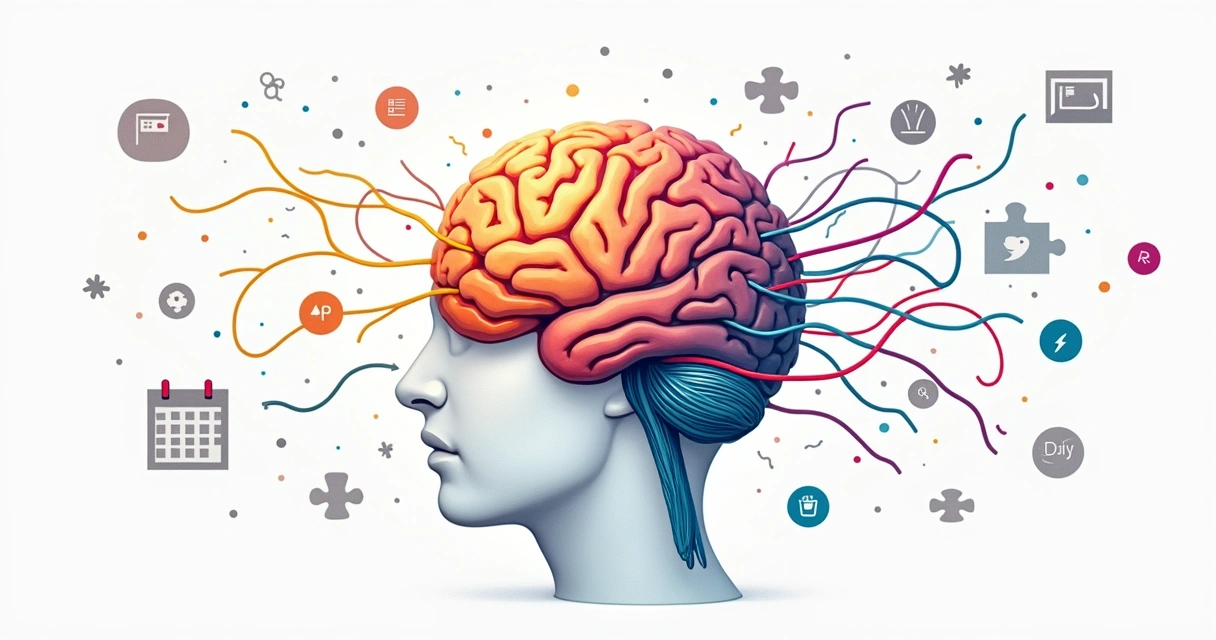
Cognitive flexibility is the brain's ability to adjust our thinking and behavior when faced with new tasks, shifting demands, or unexpected changes. It's what lets us learn new skills, adapt to surprises, and see a problem from multiple angles. More than just being open-minded, it means actively changing our approach instead of repeating the same solution even when it clearly isn't working.
Cognitive flexibility is a core executive function that helps us move from automatic reactions to intentional responses.
Scientific reviews, such as those from the University of Miami, have highlighted that this skill draws on areas of the brain like the prefrontal cortex, helping us update information, suppress habitual responses, and embrace new strategies. This adaptability is critical not just in our personal lives but in how we work and relate to others (review by the University of Miami).
Why do fixed mindsets develop?
We have all encountered moments where our thinking turns rigid. Why does this happen? There are several common reasons for the growth of a fixed mindset:
- Comfort in routine: Doing things the same way brings a feeling of safety and predictability.
- Fear of failure: Trying something new raises the risk of making mistakes and feeling embarrassed.
- Negative past experiences: If change has led to disappointment before, we may avoid it in the future.
- Social and cultural influence: Family or community beliefs can set strong definitions of “the right way.”
Over time, these habits become mental “shortcuts” that shape how we view ourselves and our potential to change. The longer they persist, the harder they are to notice—like invisible walls framing what we believe is possible.
How cognitive flexibility changes outcomes
Most of us have seen what happens when people hold tightly to existing beliefs, even when results fall short. By contrast, those with cognitive flexibility don’t just react differently—they see opportunities others miss. In our experience, people with this skill tend to:
- Switch between tasks more smoothly
- Handle stress with more ease
- Welcome critical feedback as a learning tool
- Make creative decisions under pressure
- Recover from failures without losing motivation
Several studies show the value of this flexibility. For example, research from Goethe University Frankfurt found that cognitive and emotional task-switching share neural mechanisms, suggesting that mental flexibility in thinking and feeling are closely linked (study from Goethe University Frankfurt). Another study out of Türkiye revealed that healthcare workers with strong cognitive flexibility coped better with workplace stress and anger (research conducted in Türkiye).
Mental agility changes how we respond to challenges, not just the challenges themselves.
Simple shifts to build a flexible mind
We’ve gathered some of the most practical strategies that anyone can use to foster cognitive flexibility. Each one is small but designed to slip past our mental “filters” and invite a new approach. Try them and notice what shifts for you.
Practice “why?” and “what if?”
Instead of assuming you know how or why something is done, pause to ask, “Why do we do it this way?” and “What if we tried something different?” This gentle questioning helps disrupt routine thinking without making us feel foolish for not knowing.
Revisit past conclusions
Take a belief or assumption you’ve held for a long time (for instance, “I’m just not good at public speaking”) and imagine it is open to revision. What evidence supports or disagrees with it today? The goal is not to force a change overnight, but to notice whether your old stories still fit.
Challenge routines in small steps
Switch a part of your daily routine: walk a new route, listen to different music, read a book in a new field. These subtle changes “train” the mind to accept novelty and reduce anxiety around the unexpected.
Welcome feedback and reflect
Try asking a trusted peer: “Is there another way to look at this?” When we actively invite alternative views, we shift from defending our position to learning from others.
Create a mental “pause”
Practicing a moment of pause before reacting lets us move from automatic to intentional. Next time you feel stuck or frustrated, inhale deeply, count to five, and only then consider your response. That space can be enough to alter your response patterns.
The neuroscience of cognitive flexibility
Brain research connects this skill with several regions, like the prefrontal cortex and basal ganglia, both known for attention, planning, and switching between different mental “gears.” Studies show that cognitive flexibility naturally declines with age, even if other thinking skills remain stable (research published in Neuropsychology), but that doesn’t mean we are stuck. Regular practice keeps these circuits engaged.

Research on different groups, like those with autism spectrum disorder (meta-analysis from the University of Cambridge), reveals that cognitive flexibility sometimes requires more explicit support, which makes early learning and practice valuable over time.
Small experiments in daily life
Building cognitive flexibility doesn’t require dramatic changes. Micro-experiments work well. Here are a few ways to try it out:
- Deliberately switch the order of tasks in your routine and notice how you adapt.
- Have a conversation with someone who has an opposing viewpoint, focusing not on agreement, but on understanding.
- Pause and reframe a frustration: see the problem as an opportunity for learning, not just a setback.
- When feeling stressed, name the emotion, breathe, and ask, “What else might be true here?”
- Notice and celebrate times you adapted quickly or saw a situation in a new light.
Building cognitive flexibility is an ongoing practice—each small experiment builds confidence and adaptability.
Conclusion: Growth over certainty
We have seen that becoming more cognitively flexible often starts with simple shifts, not grand gestures. By pausing to question, trying new routines, and making space for both mistakes and new perspectives, we move away from fixed mindsets that limit our choices.
Cognitive flexibility gives us the chance to see the world—and ourselves—not as fixed, but as curiously open and changeable.
When we reshape our mental habits, we gently free ourselves from assumptions and stories that no longer serve us. In doing so, we meet the pace of change in the world with clarity and a willingness to grow, rather than a reflex to defend what already is.
Frequently asked questions
What is cognitive flexibility?
Cognitive flexibility is our ability to change the way we think, act, or solve problems in response to new information or changing circumstances. It allows us to move between ideas, adjust our behavior, and see situations from more than one perspective.
How to improve cognitive flexibility skills?
We suggest practicing small changes to your routine, asking open-ended questions about familiar situations, and inviting feedback from others. Activities that encourage switching tasks, brainstorming different solutions, and learning new information can also strengthen this skill over time.
Why is breaking fixed mindsets important?
Breaking fixed mindsets allows us to learn from experiences, respond better to change, and approach challenges with creativity and resilience. People with flexible thinking are less likely to feel stuck and more likely to see setbacks as valuable sources of information.
What are examples of cognitive flexibility?
Examples include adapting to a sudden change in plans without frustration, finding another way to solve a problem when the first doesn’t work, or understanding another person’s point of view during a disagreement. These actions all rely on mentally shifting approaches as situations demand.
How can I practice flexible thinking daily?
Mix up your daily routines, challenge at least one assumption every day, and try learning something outside your usual interests. When you face a problem, pause, consider at least two solutions, and reflect on the outcomes. Even small changes make a difference over time.