

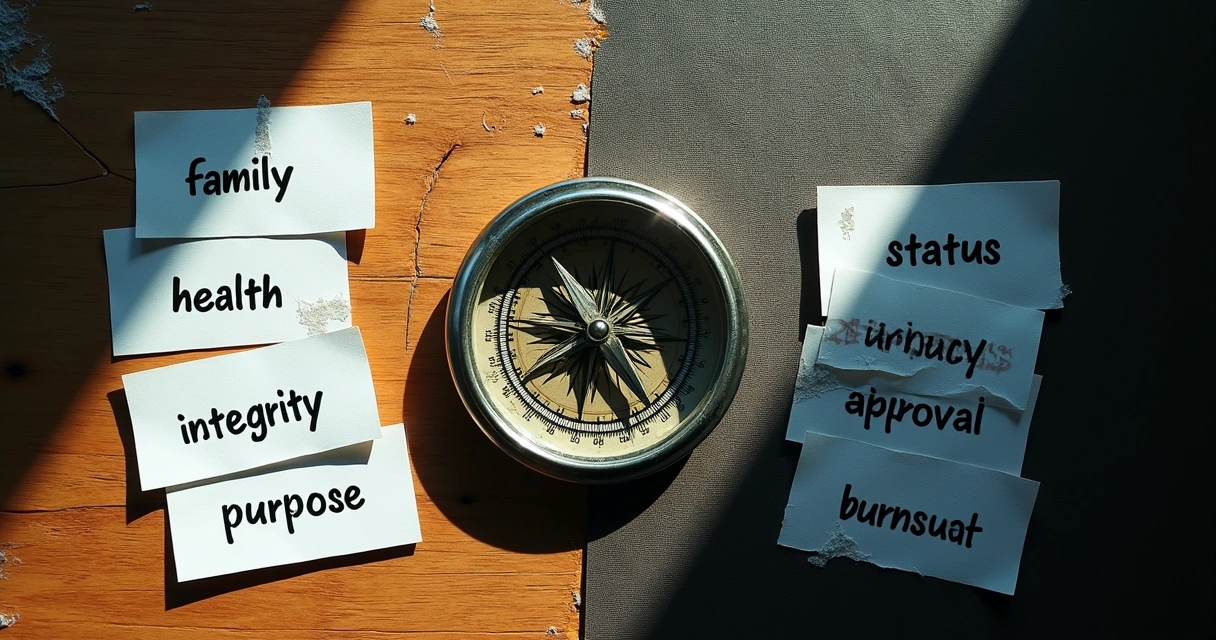
We often think of stress as a problem of mood, sleep, or energy. That is true, but it is not the full story. Chronic stress can also change the way we judge what matters. It can shift our values slowly, almost quietly, until we start acting like someone we barely recognize.
Chronic stress does not only tire the body, it can distort priorities, weaken empathy, and narrow moral focus.
In our experience, this change rarely happens in one dramatic moment. It tends to appear in small choices. A person who cared deeply about honesty starts hiding details to avoid conflict. Someone who valued patience begins snapping at loved ones. A leader who once protected fairness starts rewarding speed over respect. The person is still there, of course. But stress has taken over the steering wheel.
Why values shift under pressure
When stress becomes constant, the brain and body move into survival mode. In this state, long-term reflection loses space. Immediate relief becomes more attractive than inner coherence. We start asking, “What gets me through today?” instead of, “What kind of person am I becoming?”
That shift matters. Values need mental space, emotional regulation, and the ability to pause. Chronic stress reduces all three. It narrows attention, shortens patience, and makes threat feel close, even when there is no real danger in the room.
Pressure changes perception.
We have seen this in daily life many times. A person under prolonged tension may begin to prize control over trust, avoidance over truth, and comfort over responsibility. These are not always conscious choices. They are often adaptive responses that became too strong and stayed too long.
Some common value shifts under chronic stress include:
- Connection giving way to isolation
- Integrity giving way to convenience
- Patience giving way to irritability
- Service giving way to self-protection
- Purpose giving way to routine survival
These changes do not mean a person has lost their character forever. They usually show that their system is overloaded.
What this looks like in real life
We may notice the change first in tone, not in ideas. A kind person becomes sharp. A reflective person becomes reactive. A committed parent becomes emotionally absent. At first, people around them may say, “You are just tired.” Sometimes that is true. But when the pattern stays for weeks or months, values may be under strain.
Picture a manager who once listened well. Over time, deadlines pile up, sleep drops, and conflict rises. Meetings become cold. People are treated like obstacles. The manager tells themselves this is just being practical. Yet something deeper is happening. Stress has reduced their access to the values they once lived by.
One of the clearest signs of stress-related value change is when our behavior starts solving pressure while creating regret.

Signs that your values may be altered by stress
Not every hard season changes our values. But when stress becomes chronic, some warning signs tend to appear. We think it helps to notice patterns instead of isolated bad days.
Here are signs worth taking seriously:
- You keep making choices that feel wrong, but you say, “I have no choice.”
- You feel less empathy for people you care about.
- You justify behavior that used to bother you.
- You avoid silence because reflection feels uncomfortable.
- You feel numb about things that once had meaning.
- You become more cynical, suspicious, or emotionally hard.
- You say yes to what drains you and no to what matters.
These signs do not prove a moral failure. They point to inner misalignment. That distinction matters. Shame usually makes stress worse. Honest awareness gives us a chance to recover.
Why this can feel confusing
Stress-related value shifts are confusing because part of us still knows what is right. We may feel the gap between belief and behavior, but lack the strength to close it. That gap creates guilt, and guilt can feed more stress. Then the cycle tightens.
We also tend to confuse adaptation with identity. If we become cold, controlling, or withdrawn under pressure, we may start saying, “This is just who I am now.” We strongly disagree with that conclusion. Many stress-based changes are state-based, not identity-based. They can be reversed with proper care and steady practice.
When stress changes our values, the goal is not self-judgment. The goal is to restore inner alignment.
Interventions that help restore alignment
We do not restore values by repeating them in our mind while living in exhaustion. We restore them by working on the conditions that made them hard to live. This takes honesty and structure.
A few interventions tend to help:
- Reduce overload at the source
- Rebuild nervous system safety
- Return to clear moral language
- Practice small acts of congruence
First, reduce overload at the source. Sometimes the kindest intervention is practical. Fewer commitments. Better boundaries. More sleep. Less exposure to constant urgency. We cannot expect calm choices from a system that never exits alarm.
Second, rebuild nervous system safety. Slow breathing, walking, time without screens, rest, and emotionally safe conversations can help the body stop reading life as an endless threat. This is not a luxury. It is part of recovery.
Third, return to clear moral language. We may ask ourselves simple questions: What have we stopped honoring? Where have we become harder than we want to be? What value do we miss in our own behavior? Naming the value helps us see the path back.
Fourth, practice small acts of congruence. Big promises often fail under stress. Small actions rebuild trust. Tell the truth in one conversation. Apologize without excuses. Protect one hour of rest. Listen without interrupting. Values grow stronger when they become visible in behavior again.

Relational support matters
We rarely see our own drift clearly while we are inside it. Trusted relationships help. A wise friend, therapist, coach, or mentor can reflect patterns we normalize. They can also help us separate true values from stress reactions.
We think one honest conversation can interrupt a long period of distortion. Not because it solves everything, but because it restores perspective. Someone may say, “You do not sound like yourself.” That can be painful to hear. It can also be the beginning of repair.
Conclusion
Chronic stress can alter values by shrinking our mental space, hardening emotional responses, and pulling behavior toward survival. The result is often a painful gap between who we want to be and how we are actually living. The good news is that this gap can close. With rest, self-observation, practical limits, and repeated acts of alignment, we can recover clarity and live closer to what we truly respect.
Sometimes the first sign of healing is simple. We stop asking only how to cope, and start asking how to live in a way we can respect again.
Frequently asked questions
What is chronic stress?
Chronic stress is a prolonged state of physical and emotional strain. It happens when the body stays on alert for a long time, often because of ongoing pressure, conflict, fear, overwork, or instability. Unlike short-term stress, it does not end quickly, so it starts affecting sleep, mood, thinking, relationships, and behavior.
How does stress change my values?
Stress can change values by pushing the mind into survival mode. In that state, short-term relief starts to feel more urgent than long-term principles. We may become more reactive, less patient, more avoidant, or more self-protective. Over time, this can weaken habits linked to honesty, compassion, presence, and responsibility.
What are signs of altered values?
Signs include making choices that feel out of character, feeling numb toward things that once mattered, justifying behavior you used to reject, showing less empathy, or acting in ways that solve pressure but create regret. A steady sense of inner misalignment is also a common sign.
How can I manage chronic stress?
We can manage chronic stress by lowering avoidable overload, improving sleep, setting clearer boundaries, reducing constant urgency, and making time for recovery. Daily habits such as walking, breathing slowly, journaling, and limiting stimulation can help calm the nervous system. Support from trusted people also makes a real difference.
What interventions can help restore values?
Helpful interventions include rest, therapy or guided support, honest self-reflection, nervous system regulation, and small daily actions that match personal values. It helps to name the values that feel distant, then practice them in simple ways. Recovery is not only about feeling better. It is also about acting with more coherence again.